
Bill of Rights Day is December 15, the anniversary of the day in 1791 when the first ten amendments became part of the Constitution. Here is why the day exists, what each of the first ten amendments protects in plain words, why James Madison thought the country needed them, and a few simple ways to mark the day at home, in a classroom or with a church group.
What day is Bill of Rights Day?
December 15, every year. Congress asked for the observance in 1941, the 150th anniversary, and President Franklin D. Roosevelt proclaimed the first Bill of Rights Day on November 27 of that year. His proclamation called the first ten amendments "the great American charter of personal liberty and human dignity" and asked Americans to fly the flag and to meet "for such prayers and such ceremonies as may seem to them appropriate."
The proclamation was signed ten days before Pearl Harbor. The day was first kept on December 15, 1941, a week after the United States entered the war.
What happened on December 15, 1791?
On September 25, 1789, the First Congress sent twelve proposed amendments to the states. By December 15, 1791, three-fourths of the state legislatures had ratified ten of them. Those ten, articles three through twelve on the list Congress sent out, are what we call the Bill of Rights.
The other two have their own stories. The first article, about the size of the House, was never ratified. The second waited more than two centuries: it became the Twenty-Seventh Amendment in 1992, 203 years after Congress proposed it. It reads, in full:
"No law, varying the compensation for the services of the Senators and Representatives, shall take effect, until an election of Representatives shall have intervened."
In plain words: Congress can vote itself a raise, but not one that takes effect before the next election.
Why was the Bill of Rights added?
Several states had ratified the Constitution only after asking for amendments that would spell out the people's rights. James Madison took up the cause in the House of Representatives on June 8, 1789. His speech answers the objection head-on. Some members, he admitted, would say that a list of rights on paper changes nothing:
"It may be thought all paper barriers against the power of the community, are too weak to be worthy of attention."
He argued the opposite: that rights written into the Constitution would become principles the public knew and defended. He also pointed to what Britain's constitution left unprotected:
"The freedom of the press and rights of conscience, those choicest privileges of the people, are unguarded in the British constitution."
His first draft of a free-press clause shows how strongly he felt about it:
"The people shall not be deprived or abridged of their right to speak, to write, or to publish their sentiments; and the freedom of the press, as one of the great bulwarks of liberty, shall be inviolable."
Congress tightened his wording into the shorter clauses we know, and the House and Senate reworked his proposals over the summer before sending twelve articles to the states.
What are the first 10 amendments, in order?
Here is a one-line summary of each, with the opening words as ratified:
- First Amendment. "Congress shall make no law respecting an establishment of religion, or prohibiting the free exercise thereof..." Freedom of religion, speech, the press, peaceable assembly, and petitioning the government.
- Second Amendment. The right of the people to keep and bear arms.
- Third Amendment. No soldiers quartered in a private home in peacetime without the owner's consent.
- Fourth Amendment. Protection against unreasonable searches and seizures; warrants require probable cause.
- Fifth Amendment. Grand jury indictment for serious crimes, no double jeopardy, no forced self-incrimination, due process of law, and just compensation when private property is taken for public use.
- Sixth Amendment. A speedy and public trial by an impartial jury, the right to know the charge, to confront witnesses, to call witnesses, and to have a lawyer.
- Seventh Amendment. Trial by jury in civil cases where the value in controversy exceeds twenty dollars.
- Eighth Amendment. No excessive bail or fines, and no cruel and unusual punishments.
- Ninth Amendment. Listing some rights does not deny others the people keep.
- Tenth Amendment. Powers not given to the United States, nor denied to the states, belong to the states or to the people.
The Eighth Amendment is short enough to memorize in an afternoon: "Excessive bail shall not be required, nor excessive fines imposed, nor cruel and unusual punishments inflicted."
Bill of Rights activities for December 15
None of these needs more than the text itself and a pencil.
- Ten days, ten amendments. Start on December 6 and read one amendment aloud each evening, so the Tenth lands on the 15th. Each one takes less than a minute.
- Madison's draft against the final text. Read his free-press clause above, then the First Amendment. What did Congress keep, and what did it cut?
- The 203-year amendment. Tell the story of the Twenty-Seventh Amendment and ask: why might a rule about congressional pay have waited so long?
- Fly the flag. It is what the 1941 proclamation asked Americans to do.
- Slow down with a puzzle. A word search built from the actual text keeps a reader with each line longer than a quick read would. Our free Founding Words printable has six American history puzzles from primary sources, with an answer key, free for family, classroom and co-op use.
The Bill of Rights, word for word
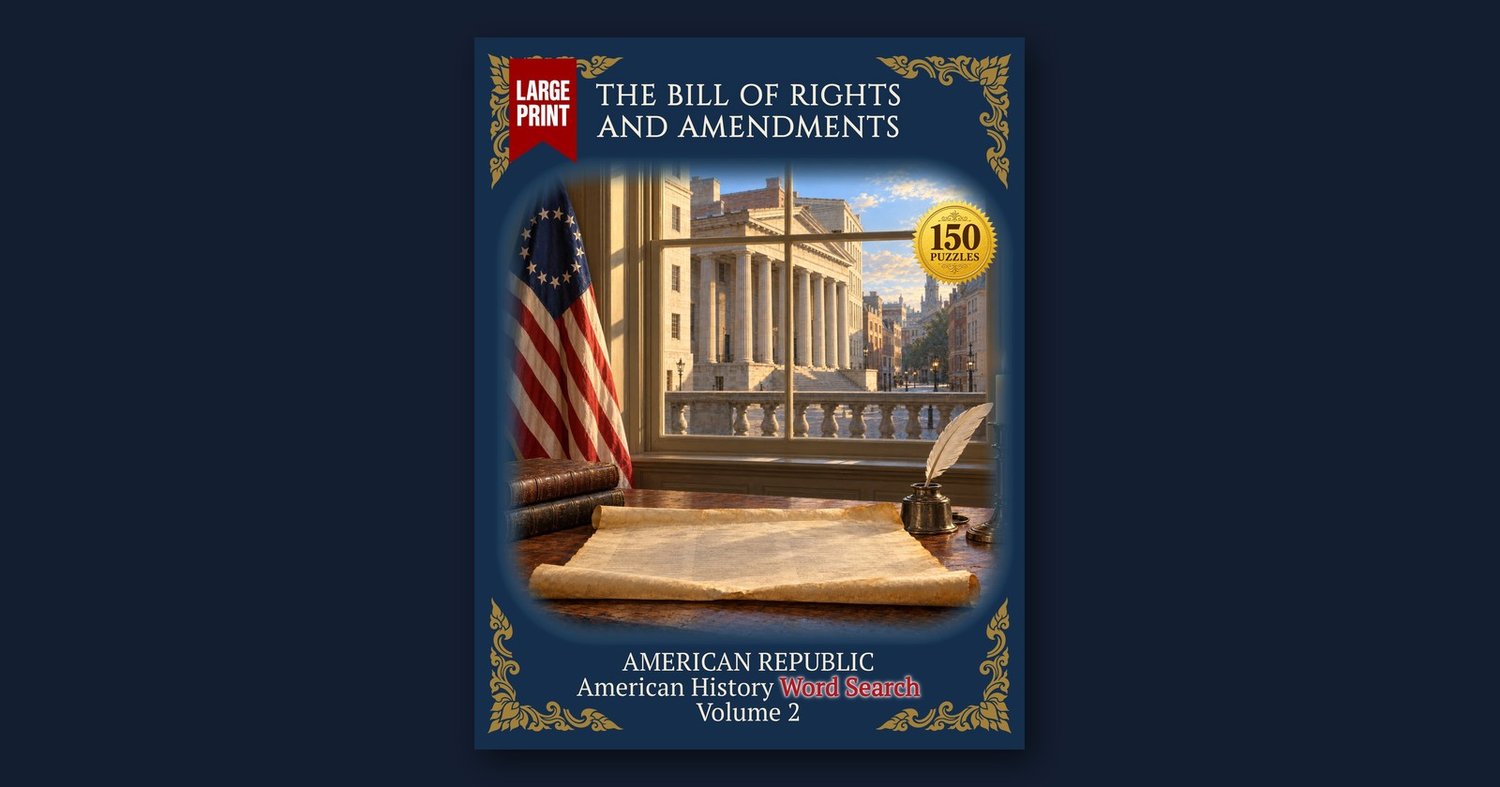
The Bill of Rights and Amendments ($14.99) is Volume 2 of our American Republic word search series. It opens with the preamble Congress wrote in 1789, gives every amendment in order from the First to the Twenty-Seventh, and closes with Madison's June 8, 1789 speech, where every quotation in the section above comes from. Each of its 150 large-print puzzles sits under a real passage, printed exactly as it was written, older spellings included. One small discovery waiting on page 13: in the First Amendment puzzle, CONGRESS runs backward across the top row.
Its companion, The United States Constitution, covers the original articles. Both come together in the American Republic Volumes 1-2 Set for $26.98, and the American Republic series page has the whole story of the series. More primary-source puzzle books are on the American History Word Search shelf.
If you liked hearing the founders in their own words, read Washington's and Lincoln's Thanksgiving proclamations. And if you are wondering whether all that word searching does any good, we looked at the research in Are Word Searches Good for Your Brain?
Sources
- National Archives, The Bill of Rights: A Transcription (dates, the twelve proposed articles, text of Amendments I-X).
- Franklin D. Roosevelt, Proclamation 2524, Bill of Rights Day, November 27, 1941, The American Presidency Project.
- James Madison, Amendments to the Constitution, 8 June 1789, Founders Online, National Archives.
- United States Courts, Bill of Rights Day.