
Homeschool laws by state differ more in what you file than in what you should keep. Every state is asking some version of the same questions: did instruction happen, in what subjects, for how long, and with what result? The forms, deadlines and offices change at the state line. The records that answer those questions don’t have to.
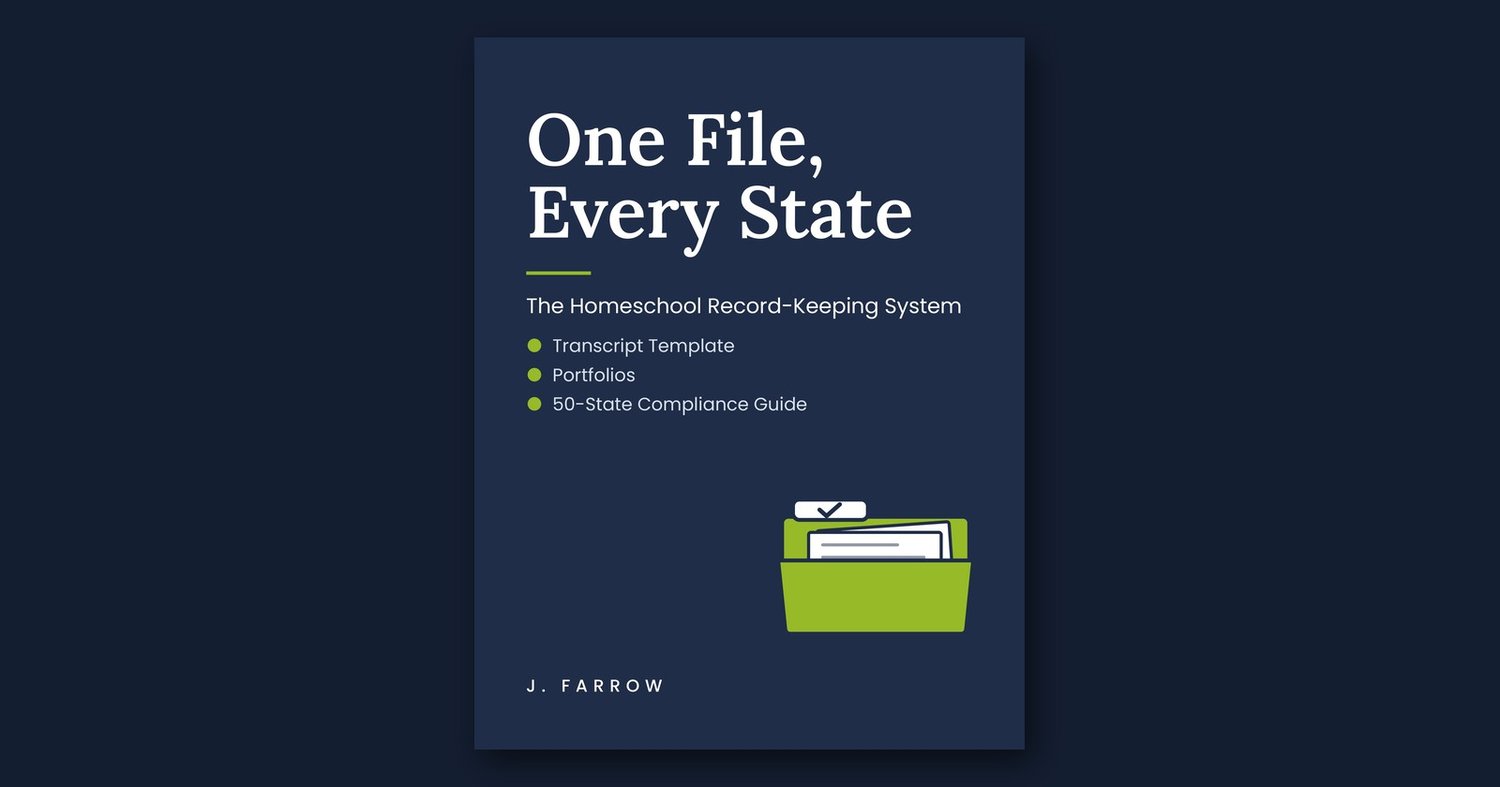
That overlap makes one rule possible for every family in the country, and it’s the rule behind One File, Every State by J. Farrow: “keep your records to the strictest standard any state sets, and file only what your state requires.” Here’s how homeschool requirements by state break down, and what to keep no matter where you live.
What do homeschool laws require?
Read any state’s homeschool law and its requirements cluster around four things the book calls the four pillars:
- Notification: telling the right office, in the right form, at the right time, that you’re homeschooling.
- Attendance: showing the school year happened, in days or hours, where the state counts them.
- Instruction: teaching the subjects your state names, if it names any.
- Assessment: proof of progress, such as a standardized test, an evaluator’s letter, or a portfolio review.
Some states lean on all four. Some lean on one. A few require none of them at all. Your state’s mix is what you’re looking for.
Why the filing half depends on your state
States don’t just ask for more or less paperwork. They ask for different paperwork, on different dates, sent to different offices:
- Texas requires no notice or testing.
- Virginia wants an annual notice of intent to the division superintendent by August 15.
- Washington wants a signed declaration of intent by September 15 (or within two weeks of the start of a public school term).
- Pennsylvania wants an affidavit, notarized or as an unsworn declaration, by August 1, and the evaluator’s certification to the superintendent by June 30.
- New York wants a notice of intent by July 1, then an individualized home instruction plan and quarterly reports.
Because the paperwork is different, doing extra doesn’t make you “more compliant.” As the book puts it, filing documents your state never asked for “can create a record or an expectation the law never required.” So the filing answer is narrow: find out exactly what your state wants, whether that’s a homeschool letter of intent or nothing at all, and send that.
Which states have the easiest homeschool laws?
The Home School Legal Defense Association (HSLDA) sorts every state into four tiers on its state law map. On that map as of October 2026, thirteen states require no notice at all: Alaska, Connecticut, Idaho, Illinois, Indiana, Iowa, Michigan, Missouri, New Hampshire, New Jersey, Oklahoma, Texas and Wyoming. (Connecticut is set to leave that list when its new annual filing begins in the 2028-29 school year.)
No notice doesn’t always mean no rules. Missouri, for one, requires a written record of subjects taught, a portfolio of work samples, and a record of evaluations, and Indiana requires daily attendance records.
Which states have the strictest homeschool laws?
Four states sit in HSLDA’s high-regulation tier: New York, Pennsylvania, Massachusetts and Rhode Island. On top of notice and testing or evaluation, these states add requirements such as approval of your plan, teaching qualifications for the parent, or visits from officials. New York is often called the strictest of all, with its annual instruction plan and quarterly reports.
The middle two tiers cover most of the country. Low-regulation states ask for a notice and little else. Moderate states add test scores, a professional evaluation, or both.
Treat the tier as a planning shortcut, not the law itself. Your state’s statute is the authority, so read the current text, and read it again each year before you plan. Homeschool laws change.
What homeschool records should you keep?
Here’s where the strictest-standard rule pays off. The most demanding states ask families to keep close to everything any other state asks for. Build your records to that level and they’ll satisfy the record-keeping side almost anywhere, survive a move to a new state, and give you exactly what a college, an employer, an evaluator or a family court wants to see.
The book calls it the gold-standard file. It has seven parts:
- A dated attendance record that logs both days and hours, so the same page answers a state that counts days and one that counts hours.
- A subject log that covers every subject you teach, including each one your state names.
- A running reading log with titles and dates.
- Dated work samples for each subject, collected through the year. These become your homeschool portfolio.
- A short progress note each quarter for each child.
- An annual standardized test or a written evaluation by a qualified evaluator.
- Your compliance papers: a copy of every notice, affidavit and letter you file, with proof of when you sent it.
Do you need records if your state doesn’t require them?
If you live in a no-notice state, that freedom is real and worth keeping. But freedom from reporting is not freedom from needing records. A few years from now your student may apply to a college, a trade program or a branch of the military, and that application will ask for a homeschool transcript. If you kept nothing, you’ll be rebuilding high school from memory.
There’s a second reason. If your state ever changes its law, families who already keep records simply add one new habit to a system they have.
How long should you keep homeschool records?
Some states require records to be available during the year, some for a set number of years, and some say nothing at all. The book’s answer covers every case: keep your compliance papers at least as long as your state requires and until your youngest child would have graduated. Keep the high school transcript, the diploma, course descriptions, test and evaluation results, and proof of compliance permanently. You are your graduate’s only registrar, and those papers get asked for years later, for jobs, licenses and enlistment.
How much time does homeschool record keeping take?
The system in One File, Every State runs on about ten minutes a week, a short check each quarter and a few hours once a year. The same records do double duty: the work samples you save each month become the annual portfolio, and the course titles, topics and time you log become the transcript when the time comes.
Where to start this week
- Find your state’s statute on home education and read the current text, not a summary of it.
- Write down what you must file, when, and with whom, and put every deadline on one calendar.
- Start an attendance and hours log today. Don’t fill in earlier days from memory.
- Make a folder for each subject’s work samples.
The book
One File, Every State: The Homeschool Record-Keeping System with a Transcript Template, Portfolios, and a 50-State Compliance Guide turns the rule above into a complete system, from a kindergarten attendance log to a college-ready transcript.
- A state-by-state filing guide for all fifty states and the District of Columbia: what to file, when, with whom, and the statute to read for yourself
- The seven-part gold-standard file, with how to keep each part
- Nineteen templates, printed full size: attendance and hours log, subject coverage log, grade book, compliance calendar, high school transcript and more
- What to do if you’re behind, if you move mid-year, or if a letter arrives from the district
- 8.5 x 11 paperback, 170 pages, $19.99
Not ready to buy? All nineteen templates are free to download and print, with no sign-up required.
Find One File, Every State in our store, or browse our Nonfiction shelf.
This article is general information, not legal advice. Confirm your state’s current requirements with your state and, when you need it, with an attorney or a homeschool legal defense organization.
Sources
- HSLDA, Homeschool Laws by State (state law map, read 30 Oct 2026)
- HSLDA, How to Comply with Pennsylvania’s Homeschool Law
- HSLDA, Texas
- New York, 8 NYCRR 100.10, Home instruction (Legal Information Institute)
- Washington, RCW 28A.200.010
- Virginia, Code of Virginia § 22.1-254.1