

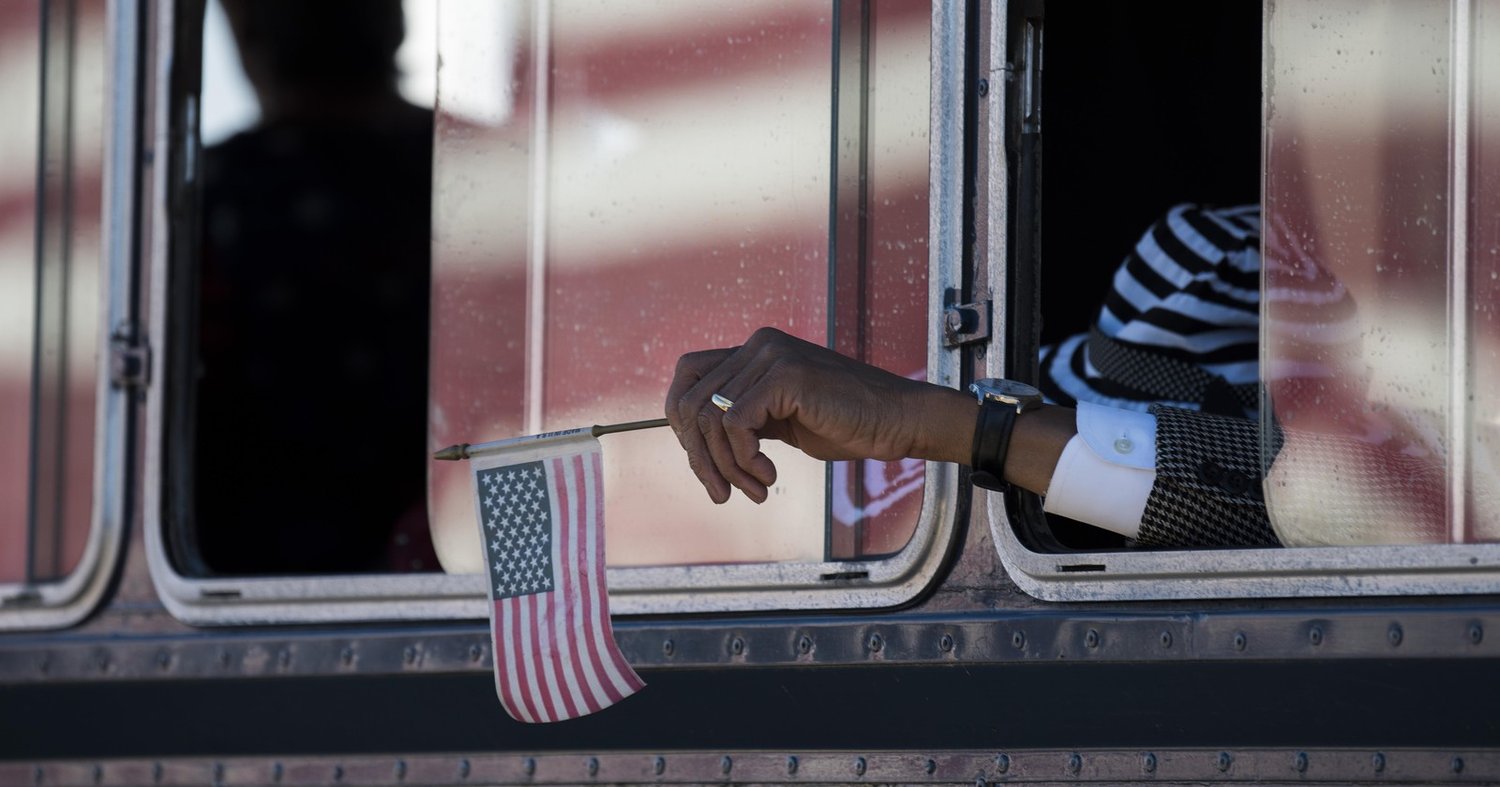
A veteran holds a flag out a bus window during the Veterans Parade in Shreveport, Louisiana, November 13, 2016. (U.S. Air Force photo by Senior Airman Damon Kasberg)
The meaning of Veterans Day comes down to two words: thank you. It is the one day on the American calendar set aside, above all, to thank the men and women who served in uniform and came home. Memorial Day remembers those who died in service. Veterans Day, as the Department of Veterans Affairs puts it, is largely intended to thank living veterans for their service.
So it is a different kind of holiday. It isn't mainly about a battlefield or a grave. It is about the man two pews up, the neighbor who flies his flag every morning, the grandfather who doesn't say much about where he was. Americans have been finding words for them for more than two hundred years.
Why do we celebrate Veterans Day?
Because coming home was never the end of the service. When the Revolution was over, George Washington's farewell orders to his army did not tell the men their duty was finished. He told them it was changing. He hoped:
"...that they should prove themselves not less virtuous and usefull as Citizens, than they have been persevering and victorious as Soldiers."
George Washington, Farewell Orders to the Armies of the United States, November 2, 1783
Eighty-one years later, Abraham Lincoln said the same thing to a regiment of Ohio men on their way home:
"When you return to your homes, rise up to the height of a generation of men worthy of a free government, and we will carry out the great work we have commenced."
Abraham Lincoln, to the 164th Ohio Regiment, August 18, 1864
They came home and kept serving
Many did exactly that. In Pittsburgh, the Freedom House Ambulance Service trained its own crews to give emergency medical care on the way to the hospital. A 1971 government report on the service said the training and life support capability of its emergency technicians were "probably unique in the nation." Some of those technicians had learned their work in a war. One of them told the reporter:
"I guess you could say there is a similarity between what I was doing in Vietnam and what I am doing here," Brown said.
The same report added that there were now "four returned GI medics and they make a welcome addition."
Most veterans do their part more quietly than that. Theodore Roosevelt described one of his Rough Riders this way:
"He saw all the fighting and did his duty with the utmost gallantry, and then left the service as he had entered it, a trooper, entirely satisfied to have done his duty..."
Theodore Roosevelt, The Rough Riders, 1899
You probably know someone like that trooper. He did his duty, came home, and never asked to be thanked for it.
Some of what they did was never written down
A few acts of courage are recorded in Medal of Honor citations. In Korea in December 1950, Navy pilot Thomas Hudner deliberately crash-landed his own plane, near enemy troops, beside a downed squadron mate whose aircraft was burning:
"With his bare hands, he packed the fuselage with snow to keep the flames away from the pilot and struggled to pull him free."
James Stockdale spent about seven and a half years as a prisoner of war in North Vietnam. His citation ends:
"By his heroic action, at great peril to himself, he earned the everlasting gratitude of his fellow prisoners and of his country."
For every citation, there are thousands of kindnesses and hard choices that no one wrote down. The veteran in your family may carry some of them. You don't need to know the story to be grateful for the person.
Gratitude from the ones who stayed home
Veterans Day also belongs to the people who waited: the wives, mothers, fathers and children who kept the home going. Lincoln saw it in 1864:
"From the fair and tender hand of women is much, very much, done for the soldier, continually reminding him of the care and thought for him at home."
Abraham Lincoln, at the Sanitary Fair in Philadelphia, June 16, 1864
That same year he sent a telegram to a fair held for the Navy in Boston. "Jack" was the old name for an ordinary sailor:
"To all, from rear-admiral to honest Jack, I tender the nation's admiration and gratitude."
And on November 10, 1864, answering a crowd outside the White House, he said something every family of a veteran already knows:
"Gold is good in its place; but living, brave, and patriotic men are better than gold."
Honor them while they are here
On June 17, 1825, fifty years to the day after the Battle of Bunker Hill, Daniel Webster stood at the site to lay the cornerstone of its monument. Surviving veterans of the battle were in the crowd, and he spoke to them directly:
"You are now where you stood fifty years ago, this very hour, with your brothers and your neighbors, shoulder to shoulder, in the strife for your country."
"VETERANS! you are the remnant of many a well-fought field. You bring with you marks of honor from Trenton and Monmouth, from Yorktown, Camden, Bennington, and Saratoga."
Webster didn't wait until those old soldiers were gone to honor them. That is the whole spirit of Veterans Day.
Bible verses for Veterans Day, and a debt we never finish paying
President William McKinley wrote in 1898:
"The debt of gratitude which we owe to the Nation's defenders can never be completely repaid either by this or future generations..."
Scripture gives us the plain instruction:
"Render therefore to all their dues: tribute to whom tribute is due; custom to whom custom; fear to whom fear; honour to whom honour."
Romans 13:7 (KJV)
And many who served answered a call that sounds a great deal like Isaiah's:
"Also I heard the voice of the Lord, saying, Whom shall I send, and who will go for us? Then said I, Here am I; send me."
Isaiah 6:8 (KJV)
How to thank a veteran on Veterans Day
- Say it by name. "Thank you for your service, Mr. Harris" lands differently than a passing word.
- Ask, then listen, or don't ask at all. Some veterans want to tell their story. Some never will. Both are theirs to decide.
- Write it down. A short note can be kept and read again long after the day is over.
- Remember the family. Thank the spouse, the parent, the child who did the waiting.
- Keep it up after November 11. The people Webster, Lincoln and Washington honored needed their country's thanks every day of the year. So do ours.
To every veteran reading this, on Veterans Day and every day: thank you. We're glad you came home.
Sources
- U.S. Department of Veterans Affairs, Veterans Day Facts and Information
- George Washington, Farewell Orders to the Armies of the United States, Rocky Hill, November 2, 1783 (Founders Online, National Archives)
- Abraham Lincoln, Address to the 164th Ohio Regiment, August 18, 1864; Address at the Sanitary Fair, Philadelphia, June 16, 1864; Telegram to the Sailors' Fair, Boston, November 1864; Response to a Serenade, November 10, 1864 (Collected works, Project Gutenberg)
- Richard F. Long, "Ambulance Service Comes to the Inner City," Opportunity (U.S. Office of Economic Opportunity), 1971, pp. 8-9
- Theodore Roosevelt, The Rough Riders (1899)
- Naval History and Heritage Command, Thomas Hudner; POW Network, James Bond Stockdale
- Congressional Medal of Honor Society, citations of Lt. (j.g.) Thomas J. Hudner Jr. (Chosin Reservoir, Korea, December 4, 1950) and Capt. James B. Stockdale (Hoa Lo Prison, Hanoi, 1969)
- Daniel Webster, Address at the Laying of the Corner Stone of the Bunker Hill Monument, June 17, 1825
- William McKinley, Letter to the Gettysburg Committee on Memorial Day Exercises, May 20, 1898
- Holy Bible, King James Version: Romans 13:7; Isaiah 6:8
- Photo: U.S. Air Force, Senior Airman Damon Kasberg, Shreveport hosts Veterans Parade (public domain)