

Washington's and Lincoln's Thanksgiving proclamations are the two most famous calls in American history to set aside a day of thanks to God. Here is what each one actually said, why it mattered, and how the holiday came to land on the fourth Thursday of November.
What did George Washington's Thanksgiving proclamation say?
On October 3, 1789, a few days after Congress asked him to, President George Washington recommended "Thursday, the 26th day of November next" as a national day of thanksgiving.
He opened with a sentence that still reads like a statement of purpose:
"Whereas it is the duty of all nations to acknowledge the providence of Almighty God, to obey His will, to be grateful for His benefits, and humbly to implore His protection and favor; …"
And he named the day itself:
"Now, therefore, I do recommend and assign Thursday, the 26th day of November next, to be devoted by the people of these States to the service of that great and glorious Being who is the beneficent author of all the …"
Notice what he asks for. Not a feast, not a parade, but a day "devoted" by the people to the service of God.
Washington proclaimed a second national day of thanksgiving on January 1, 1795, set for Thursday, February 19. Its call is just as plain:
"In such a state of things it is in an especial manner our duty as a people, with devout reverence and affectionate gratitude, to acknowledge our many and great obligations to Almighty God and …"
What did Lincoln say in his Thanksgiving proclamation?
By 1863 the country was more than two years into the Civil War. Sarah Josepha Hale, editor of Godey's Lady's Book, had been urging a national day of thanksgiving since 1846, and on September 28, 1863, she wrote to President Lincoln directly. Five days later, on October 3, 1863, Lincoln set apart the last Thursday of November as a day of thanksgiving and praise.
In the middle of a war, he wrote that the year had still been full of blessings, and he was careful to say where they came from:
"They are the gracious gifts of the Most High God, who, while dealing with us in anger for our sins, hath nevertheless remembered mercy."
That one sentence holds gratitude and humility together. The nation was not thanking itself.
Lincoln had called for thanks before. In April 1862 he proclaimed a day of thanksgiving for Union victories:
"It has pleased Almighty God to vouchsafe signal victories to the land and naval forces engaged in suppressing an internal rebellion, and at the same time to avert from our country the dangers of foreign …"
And in October 1864, with the war still going, he did it again:
"It has also pleased our Heavenly Father to favor as well our citizens in their homes as our soldiers in their camps and our sailors on the rivers and seas with unusual health."
Who made Thanksgiving a national holiday?
Washington issued the first national proclamation, but the presidents after him did not call one every year. Lincoln's 1863 proclamation began the yearly custom: from then on, the president proclaimed a Thanksgiving Day each autumn, usually for the last Thursday of November. In 1870, Congress made Thanksgiving a legal holiday in the District of Columbia, along with New Year's Day, Independence Day and Christmas, though the president still chose the date.
Why is Thanksgiving on the fourth Thursday of November?
In 1939 the last Thursday fell on November 30, and President Franklin D. Roosevelt moved Thanksgiving a week earlier. Some states followed him and some did not, so the country had two Thanksgivings that year. In 1941 Congress settled it: the House passed a resolution for the last Thursday, the Senate changed it to the fourth Thursday so the date would not shift in months with five Thursdays, and Roosevelt signed it on December 26, 1941.
The custom kept going
Later presidents kept the proclamation. A few lines from theirs, as they wrote them:
"We approach the season when, according to custom dating from the garnering of the first harvest by our forefathers in the New World, a day is set apart to give thanks even amid hardships to Almighty …"
Herbert Hoover, 1931
"May we on that day, in our homes and in our places of worship, individually and as groups, express our humble thanks to Almighty God for the abundance of our blessings and may we on that …"
Harry S. Truman, 1945
"Let us demonstrate in our lives our humble thanks to God for His beneficence in the year which is past, and let us ask His guidance in the year to come."
Dwight D. Eisenhower, 1954
Read one aloud at your Thanksgiving table
If your family says grace before the meal, try reading one of these first. Lincoln's 1863 sentence takes less than a minute and gives everyone something to think about while the turkey is passed. Washington's opening line works well too. Let a grandchild read it; the old wording ("hath," "implore," "providence") is a small history lesson by itself.
Where these words come from
Every passage quoted above is printed in one of two large-print American history word search books. Each puzzle page carries a passage in the words of the person who wrote it, and the puzzle words come from that passage.
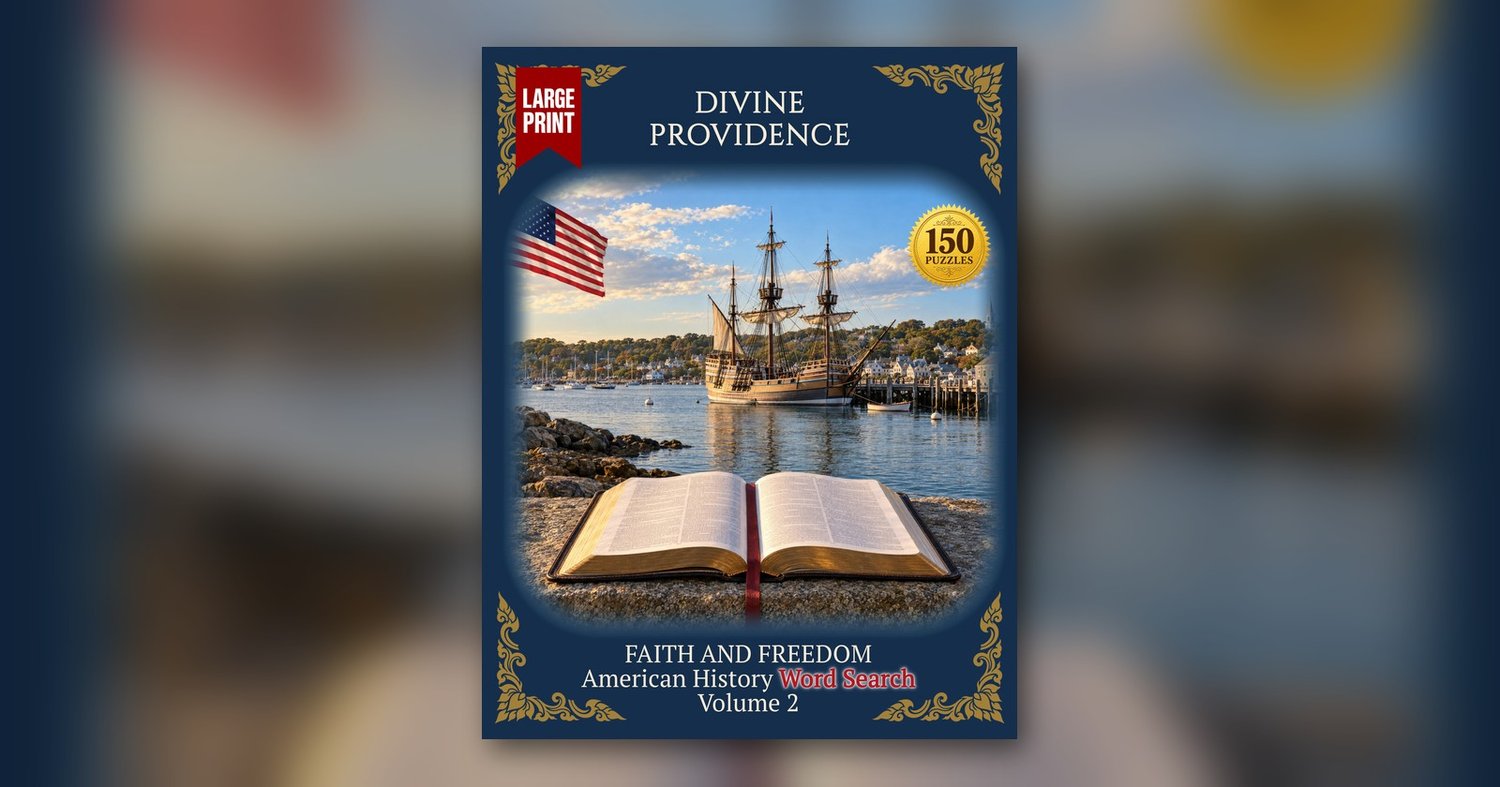
- Divine Providence: American History Word Search (Faith and Freedom, Volume 2) follows the presidential Thanksgiving proclamation from Washington's 1795 proclamation to 2025, one president's words at a time.
- George Washington: American History Word Search (Founding Fathers, Volume 1) includes four puzzles from his 1789 Thanksgiving Proclamation, alongside his inaugural addresses and Farewell Address.
Both are in the store, with the rest of the Faith and Freedom series and the Founding Fathers series.
They're printed paperbacks, so give them time to reach you.
Want to try one first? Founding Words is a free printable of six large-print American history word searches, with an answer key.
Wondering whether puzzles like these do your mind any good? We looked at what the studies say in Are Word Searches Good for Your Brain?
Another founding-era date worth marking: Bill of Rights Day, December 15. Here is what the first ten amendments protect, and why Madison proposed them.
Sources
- George Washington, Proclamation: A National Thanksgiving, October 3, 1789 (The American Presidency Project)
- George Washington, Proclamation 6: Day of Public Thanksgiving, January 1, 1795 (The American Presidency Project)
- Abraham Lincoln, Proclamation 88: Day of Public Thanksgiving for Victories, April 10, 1862 (The American Presidency Project)
- Abraham Lincoln, Proclamation 106: Thanksgiving Day, 1863 (The American Presidency Project)
- Abraham Lincoln, Proclamation 118: Thanksgiving Day, 1864 (The American Presidency Project)
- Lincoln and Thanksgiving (National Park Service, Lincoln Home)
- Thanksgiving as a Federal Holiday (National Archives, Prologue blog)
- Congress Establishes Thanksgiving (National Archives, Center for Legislative Archives)